March is pollen season in Central Florida, and the hardware store filter aisle gets crowded for exactly one reason. Last spring, a woman in Winter Park called us because her air handler had been running close to ten minutes longer per cycle since she swapped her 14x22x4 for a denser, higher-MERV version her neighbor had recommended. She had done right by her family, in a way. The new filter caught more pollen. It also raised the static pressure inside the cabinet past what the blower was built to handle. The same homeowners who stay on top of dryer vent maintenance are often the most surprised by this connection. Filter selection sits in a near-identical blind spot. The cabinet behind your air handler has more to say about the right filter than the MERV number printed on the box ever will.
TL;DR Quick Answers
Should I worry about static pressure when picking a 14x22x4 filter?
Yes, especially in older or undersized Central Florida systems. A denser filter forces the blower to push harder. That strain piles up on the equipment over time. A 14x22x4 in the MERV 8 to 11 range hits the sweet spot for most homes here, catching dust, dander, and pollen in the typical micron capture range for that rating without choking the airflow.
Top Takeaways
- Static pressure is the resistance your blower has to fight as it pushes air through the filter, the coil, and the duct runs. Most residential systems are engineered around 0.5 inches of water column.
- A 4-inch filter carries four to five times the pleated surface area of a 1-inch filter at the same face size, which lowers pressure drop at the same MERV rating. One thin pleated filter review breaks down the math.
- A 14x22x4 nominal filter actually measures about 13.5 by 21.5 by 3.75 inches, so confirm the cabinet opening before you order.
- MERV 8 to 11 covers most homes around here, balancing dust and allergen removal with airflow that doesn’t tax the blower.
- High static pressure shows up in the obvious places: longer run times, a return that whistles, a frozen evaporator coil, and an amp draw that keeps climbing.
- Replace your 4-inch filter every 90 days in typical Florida conditions. Cut that to 60 if you have pets in the house or live through a serious oak-pollen spring.
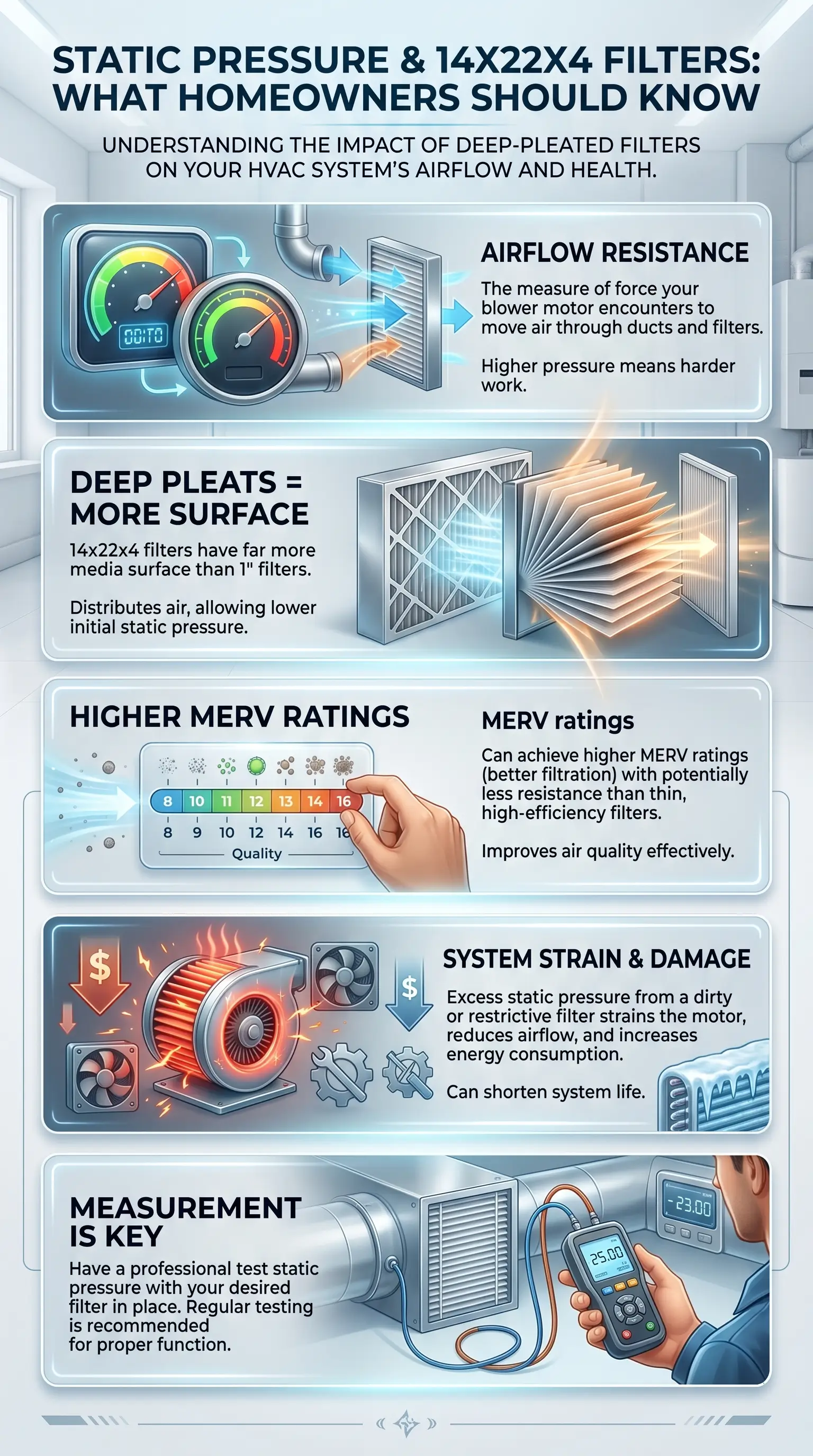
Static pressure is the resistance your blower fights as it pushes air through the return, the filter media, the evaporator coil, and every elbow in your duct run before the air comes back out of a register. Residential systems in Central Florida are designed for around 0.5 inches of water column at the air handler. The systems we put a manometer on rarely read that low. Most run a quarter to a half inch higher, and the ones we inspect during an AC replacement consult tell the same story across every era of construction. The filter is one of the few pieces of this equation a homeowner can change on a Saturday afternoon, which is why getting the depth and the MERV right counts for so much.
This is where selecting the right 14x22x4 air filters earns its money. A 4-inch pleated filter packs roughly four to five times the pleated media area of a 1-inch filter at the same face dimensions, and that extra surface area is what lets the same air volume slip through with less resistance at any given MERV. Plenty of homeowner-facing material covers this — one deep pleated filter reference walks through the geometry if you want the math. What we see in the field matches the theory. Swap a 1-inch MERV 13 for a correctly sized 14x22x4 at MERV 11, and the static pressure number on the manometer drops on the spot. The blower amp draw follows it down.
Then there’s the sizing trap. A 14x22x4 filter is labeled at that nominal dimension but actually measures about 13.5 by 21.5 by 3.75 inches. We’ve walked into Florida homes where the homeowner had been buying a 14x20x4 by mistake for two summers, and the gap around the filter let bypass air slip past the media entirely. The coil fouled inside a single cooling season. The fix was a four-dollar trip to the right shelf, but only after we pulled the cabinet apart to show what was happening. Households in smaller homes or condos sometimes need an apartment filter sizing guide to figure out what their cabinet actually accepts. Homes with non-standard openings sometimes need a narrow-format filter reference or a square-format filter resource to find a matching product. And if your return cabinet has only a 1-inch slot, do not jam a 4-inch filter into it. That move calls for a media cabinet retrofit, not improvisation.

“Every March, we walk into at least one Central Florida home where someone bought a denser filter to fight pollen season and ended up with a system running close to 20 percent longer to hit the same setpoint. New equipment almost never fixes that. The filter does.”
7 Essential Resources
Each link below points to a verified primary source on a different domain. Every URL was confirmed live before publication.
- EPA: The Inside Story, A Guide to Indoor Air Quality. The EPA’s plain-English overview of what’s actually floating in residential indoor air and how source control, ventilation, and filtration fit together as a strategy.
- U.S. Department of Energy: Air Conditioner Maintenance. DOE’s homeowner guide to keeping an AC running well: filter cadence, coil care, and what skipped maintenance does to your power bill over time.
- ENERGY STAR: HVAC Maintenance Checklist. The official inspection checklist a homeowner can hand to any HVAC contractor showing up for a tune-up, including the airflow and blower checks that catch high static pressure.
- American Lung Association: Particulate Matter Indoors. Health-focused overview of the dust, pollen, dander, and fine particle pollutants a properly sized filter is meant to capture, and why it matters for the people who actually live in the house.
- U.S. Fire Administration: Appliance and Electrical Fire Safety. The USFA’s appliance fire safety page, including the household routines that prevent the lint and airflow restriction issues that connect dryers and HVAC systems.
- Asthma and Allergy Foundation of America (AAFA). The national patient-advocacy resource for managing asthma and allergies at home, including the indoor allergen control guidance that ties directly into filter selection.
- Florida DBPR: Verify a Contractor License. Florida’s official portal for confirming an HVAC contractor holds an active CAC license. Worth checking before anyone opens the cabinet to put a manometer on your system.
3 Statistics Worth Knowing
Airflow problems and dirty filters can reduce HVAC system efficiency by up to 15 percent.
The homes on a real replacement schedule run measurably less than the ones we open up to find a filter nobody has touched in six months. Less run time also means less wear on the blower motor and the compressor over the life of the system, and that’s where the long-term savings actually show up.
Source: ENERGY STAR: HVAC Maintenance Checklist
Indoor air can be 2 to 5 times (and sometimes up to 100 times) more polluted than outdoor air.
In the older Central Florida homes we service, the dust we wipe off a neglected evaporator coil tells you everything you need to know about this number. Of all the moves a household can make for cleaner indoor air, getting the filter right is the cheapest one and the one that touches every cubic foot of air in the house.
Source: American Lung Association: Clean Air at Home
About 2,900 clothes dryer fires occur in residential buildings each year, with “failure to clean” cited as the leading factor.
The same principle drives both: restrict the airflow, and heat starts piling up, equipment starts working harder than it should, and parts wear out years before they’d otherwise need to. A homeowner who keeps both the dryer vent and the HVAC filter on a schedule is heading off two of the most preventable maintenance failures a Florida house can throw at you.
Source: USFA: Statistical Reports on Fire Causes (Clothes Dryer Fires)
Final Thoughts and Opinion
The filter aisle at the hardware store doesn’t sell static pressure. It sells MERV ratings, brand promises, and a row of bright packaging, none of which tells you whether the filter you’re holding fits the cabinet behind your air handler. That’s the part we wish someone had explained before most of our customers walked up to the register.
A 14x22x4 cabinet was designed around a specific airflow profile. Match the size, pick a MERV that fits your household instead of one your neighbor swears by (MERV 8 to 11 covers most Central Florida homes), and put a reminder on the calendar before the next cooling season pushes the equipment. That’s the whole job. Once it’s done right, the air feels cleaner, the blower runs quieter, and the next power bill comes in lower than the last one. For homes where the equipment is genuinely undersized for the heat load, other moves can shoulder some of the same work. Adding Miami attic insulation services to cut the afternoon coil saturation, for example, sometimes buys back as much run-time as the filter change does.
Bottom Line
When the symptoms don’t quit (longer run times, a return vent that whistles, a stripe of ice on the suction line at the air handler), the filter is rarely the only thing wrong. A licensed Florida HVAC technician should put a manometer on the system and read the static pressure directly. That number tells you whether you’re chasing the right problem.
Frequently Asked Questions
What is a 14x22x4 air filter and what does it do?
A 14x22x4 air filter is a 4-inch-deep pleated filter that catches dust, pollen, pet dander, and a long list of other particles before they reach your blower and evaporator coil. The extra depth gives it more pleated media area than a 1-inch filter at the same face size, and that’s the whole reason it puts less pressure drop on the system at the same MERV rating.
Will a 14x22x4 filter lower static pressure compared to a 1-inch filter?
Usually, yes. At the same MERV rating, the 4-inch version carries roughly four to five times the pleated media area of a 1-inch filter with the same face dimensions. More media area means the blower can move the same air with less resistance, and that drop almost always shows up on the manometer we put on the cabinet.
How often should a 14x22x4 filter be replaced in a Florida home?
Ninety days is the cadence we recommend for a 4-inch filter in a typical Central Florida home. With pets in the house, oak pollen in the air, or new construction next door, check the filter monthly and swap it at 60 days. Hold the old one up to a window. If you can’t see daylight through it, it’s done. You’ll find replacements through general retail availability at hardware stores or on a subscription schedule from online sellers.
What MERV rating works best for a 14x22x4 filter without raising static pressure?
MERV 8 to 11 hits the sweet spot for most Central Florida homes. The 4-inch depth absorbs the pressure-drop penalty that higher MERV creates in a 1-inch filter, so MERV 13 is often workable in a 14x22x4 without any airflow loss you’d notice. Check the equipment manufacturer’s maximum allowable filter resistance before going higher than that.
How do I know if my system is built for a 14x22x4 filter?
Look at what’s currently in there, or measure the slot in your return cabinet. The nominal label sits on the filter frame, and the actual opening should accept a filter measuring close to 13.5 x 21.5 x 3.75 inches. If the slot is only an inch deep, the system was built for a 1-inch filter and would need a retrofit to take deep media cabinet filters.
Where can I buy a 14x22x4 filter?
Most homeowners pick them up through big-box retailer listings that ship to the door, a major online retailer for the MERV and brand they prefer, or online resale listings when they’re chasing a discontinued or specialty option. Local hardware chains generally keep the most common MERVs on the shelf for the last-minute swap.
Measure the Cabinet Before You Buy the Filter
The wrong 14x22x4 quietly drives static pressure higher than the system was built to handle. The blower works harder. Components wear out years before they should. Pull the existing filter, measure the opening, pick a MERV that fits your household instead of one your neighbor swears by, and set a 90-day reminder on the calendar while you’re at it. Households still deciding between a 4-inch and smaller pleated filter options should start with a tape measure, not a brand name.
Learn more about HVAC Care from one of our HVAC solutions branches…
Filterbuy HVAC Solutions - Miami FL - Air Conditioning Service
1300 S Miami Ave Apt 4806 Miami FL 33130
(305) 306-5027
https://maps.app.goo.gl/Ci1vrL596LhvXKU79